During my recent visit to Canada, I stopped by the Heritage Park Historical Village in Calgary. The park has 127 acres of parkland that showcases some original and carefully relocated refurbished buildings, such as a bank, ice cream shop, train station, gas station, synagogue, church, school, and farms. All placed across the park’s land to recreate Calgary in its raw, early form.
As someone living across the pond, whose eyes have ticked most of all European countries, valuing and appreciating different traditions and cultures, I was genuinely impressed with the quality of work the Heritage Park has done there.
Walking through the historical village felt like stepping into a Netflix series like Anne with an E, a true time travel experience. Staff were dressed in period clothes, and they were all polite and joyful. I captured these memories that now live in a reel, which you can watch here: 📽: https://www.instagram.com/p/DM1hd2nR_SK/?hl=en ️
But what stayed with me most was the idea of heritage itself.
We often associate heritage with possessions, tangible things or things from the past.
But what about the intangible? Culture. Traditions.
Heritage, in life, is something beyond monetary value or time: it’s a never-ending, priceless asset. Something we pass on. Something we transmit. Now, today, tomorrow and after. Especially the intangible ones.
Like Culture.
In Latin, “culture” or “cult” shares the same root, colere, meaning to cultivate, care for, or worship. While culture (from cultura) evolved to mean the shared customs and values of a society (refers to what belongs to a particular group that shares something in common), cult (from cultus), where it retained a more focused meaning tied to religious devotion or intense admiration.
Essentially, culture translates as a living legacy which has to be preserved and shared and a living responsibility to carry, respect, and pass on.
Do we still feel connected to our cultural heritage today? Are we passing down important values and traditions? What do we represent in our lives? Think about the generations before you. Are there any key traits that still matter today? I’m not talking about starting a business, having an entrepreneurial mindset, or inheriting things. I mean values that money or power cannot buy, like principles, customs, character, and personal traits. Are we aligned with our cultural heritage? Does it seem like cultures are disappearing over time? Some might say that with modern technology, we are creating new cultures or blending old ones to make them more adaptable.
I understand that preserving cultures and traditions can be challenging. However, we should each strive to keep our cultural heritage alive. This means promoting it in a way that educates and inspires others, without pressuring or demanding that they adopt it. Instead, we should encourage understanding and respect.
The concept of culture should remain within communities and coexist harmoniously with one another. No culture should be altered, diminished, or considered more important or powerful than another.
In short, ‘heritage’ literally means:
To pass down to others. To transmit. A living responsibility (legacy) to embody one’s values, ethics, and memory.
And, to REPRESENT.
I’ve always held onto the saying, “Teaching is like learning twice.”
Teaching is an act of transmitting knowledge. Heritage is the closest thing to it.
We can even call heritage the oldest teacher of all time. Remember, before we went to school, our first teachers were our siblings and, before them, our parents and grandparents. For years, they were our first and most valued teachers.
Most of the time, success comes from failures, and this implies learning. Endless learning. Takes humbling time, attitude and dedication. Living and sharing this legacy is a privilege. By representing generations of generations who came before us.
Representing means honouring.
Thus, passing our heritage on is a sacred responsibility, I’d say, on par with honouring God. Crazy, right? Well, not really…
I’m sure you heard this at some point in your life. “Honour your parents, so that you will live longer.” Shemot / Exodus 20:12
There are many ways of addressing the actual condition of paying our honours/representing. As we talk about cultural heritage, it’s about honouring culture, traditions, values – representing somehow some of the goodness they (our ancestors) passed on through generations.
Which leads to the second part of the sentence, something quite promising. It says we will be granted longer days here on earth. So, by passing on our cultural heritage, this does not just qualify as a responsibility; it is a promise. There is a reward for that.
A living promise that sustains, promotes and protects life, known as longevity.
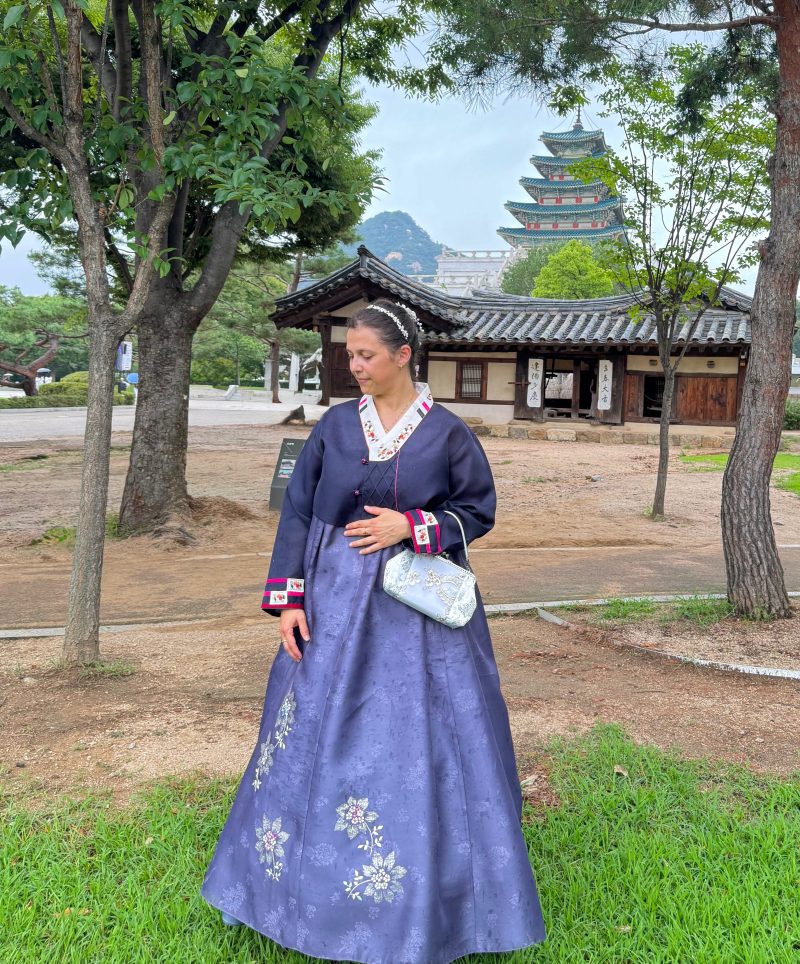
After my trip to Canada, I began another adventure by visiting South Korea for the first time. By then, I had already started this cultural heritage reflection piece here, covering the heritage park as mentioned above. During my time in Seoul, I had the wonderful experience of immersing myself in the local cultural heritage by wearing a Hanbok, the traditional Korean dress. This attire is typically worn by Koreans during ceremonies, festivals, and traditional events. Thus, if you wish to enter Gyeongbokgung Palace, you can rent a Hanbok, which enhances the experience even further. Wearing the Hanbok allowed me to appreciate the importance of making cultural heritage accessible and vibrant.
📽 Here is a link to view my reels showing this experience: https://www.instagram.com/p/DNsNqZ7wryD/?hl=en
In conclusion, it is evident that previous generations valued their cultural heritage, enabling both locals and visitors to access it today like I did.
That’s the beauty of passing it on. Time cannot diminish its value.
And I’m not just referencing the Heritage Park in Calgary or dressing up as a royal Korean empress. I mean this in a broader sense.
So go on, be exemplary.
Proudly embrace, represent and celebrate your cultural heritage, passing it on respectfully. Future generations will appreciate this invaluable legacy.
All blessings,
Tici
 Ticiele de Camargo