-
Immersive Experiences: Valuing Cultural Heritage Globally
BY
ON
During my recent visit to Canada, I stopped by the Heritage Park Historical Village in Calgary. The park has 127 acres of parkland that showcases some original and carefully relocated refurbished buildings, such as a bank, ice cream shop, train station, gas station, synagogue, church, school, and farms. All placed across the park’s land to recreate Calgary in its raw, early form.As someone living across the pond, whose eyes have ticked most of all European countries, valuing and appreciating different traditions and cultures, I was genuinely impressed with the quality of work the Heritage Park has done there.
Walking through the historical village felt like stepping into a Netflix series like Anne with an E, a true time travel experience. Staff were dressed in period clothes, and they were all polite and joyful. I captured these memories that now live in a reel, which you can watch here: 📽: https://www.instagram.com/p/DM1hd2nR_SK/?hl=en ️
But what stayed with me most was the idea of heritage itself.
We often associate heritage with possessions, tangible things or things from the past.
But what about the intangible? Culture. Traditions.
Heritage, in life, is something beyond monetary value or time: it’s a never-ending, priceless asset. Something we pass on. Something we transmit. Now, today, tomorrow and after. Especially the intangible ones.
Like Culture.
In Latin, “culture” or “cult” shares the same root, colere, meaning to cultivate, care for, or worship. While culture (from cultura) evolved to mean the shared customs and values of a society (refers to what belongs to a particular group that shares something in common), cult (from cultus), where it retained a more focused meaning tied to religious devotion or intense admiration.
Essentially, culture translates as a living legacy which has to be preserved and shared and a living responsibility to carry, respect, and pass on.
Do we still feel connected to our cultural heritage today? Are we passing down important values and traditions? What do we represent in our lives? Think about the generations before you. Are there any key traits that still matter today? I’m not talking about starting a business, having an entrepreneurial mindset, or inheriting things. I mean values that money or power cannot buy, like principles, customs, character, and personal traits. Are we aligned with our cultural heritage? Does it seem like cultures are disappearing over time? Some might say that with modern technology, we are creating new cultures or blending old ones to make them more adaptable.
I understand that preserving cultures and traditions can be challenging. However, we should each strive to keep our cultural heritage alive. This means promoting it in a way that educates and inspires others, without pressuring or demanding that they adopt it. Instead, we should encourage understanding and respect.
The concept of culture should remain within communities and coexist harmoniously with one another. No culture should be altered, diminished, or considered more important or powerful than another.
In short, ‘heritage’ literally means:
To pass down to others. To transmit. A living responsibility (legacy) to embody one’s values, ethics, and memory.
And, to REPRESENT.
I’ve always held onto the saying, “Teaching is like learning twice.”
Teaching is an act of transmitting knowledge. Heritage is the closest thing to it.
We can even call heritage the oldest teacher of all time. Remember, before we went to school, our first teachers were our siblings and, before them, our parents and grandparents. For years, they were our first and most valued teachers.
Most of the time, success comes from failures, and this implies learning. Endless learning. Takes humbling time, attitude and dedication. Living and sharing this legacy is a privilege. By representing generations of generations who came before us.
Representing means honouring.
Thus, passing our heritage on is a sacred responsibility, I’d say, on par with honouring God. Crazy, right? Well, not really…
I’m sure you heard this at some point in your life. “Honour your parents, so that you will live longer.” Shemot / Exodus 20:12
There are many ways of addressing the actual condition of paying our honours/representing. As we talk about cultural heritage, it’s about honouring culture, traditions, values – representing somehow some of the goodness they (our ancestors) passed on through generations.
Which leads to the second part of the sentence, something quite promising. It says we will be granted longer days here on earth. So, by passing on our cultural heritage, this does not just qualify as a responsibility; it is a promise. There is a reward for that.
A living promise that sustains, promotes and protects life, known as longevity.
After my trip to Canada, I began another adventure by visiting South Korea for the first time. By then, I had already started this cultural heritage reflection piece here, covering the heritage park as mentioned above. During my time in Seoul, I had the wonderful experience of immersing myself in the local cultural heritage by wearing a Hanbok, the traditional Korean dress. This attire is typically worn by Koreans during ceremonies, festivals, and traditional events. Thus, if you wish to enter Gyeongbokgung Palace, you can rent a Hanbok, which enhances the experience even further. Wearing the Hanbok allowed me to appreciate the importance of making cultural heritage accessible and vibrant.📽 Here is a link to view my reels showing this experience: https://www.instagram.com/p/DNsNqZ7wryD/?hl=en
In conclusion, it is evident that previous generations valued their cultural heritage, enabling both locals and visitors to access it today like I did.
That’s the beauty of passing it on. Time cannot diminish its value.
And I’m not just referencing the Heritage Park in Calgary or dressing up as a royal Korean empress. I mean this in a broader sense.
So go on, be exemplary.
Proudly embrace, represent and celebrate your cultural heritage, passing it on respectfully. Future generations will appreciate this invaluable legacy.
All blessings,Tici
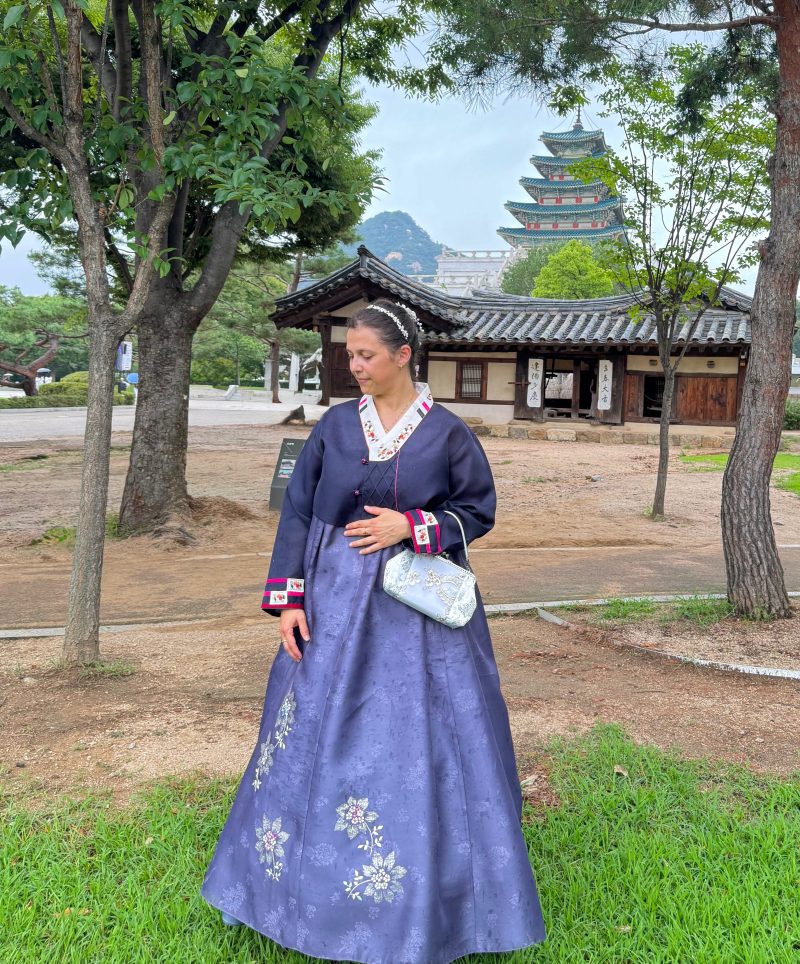
Embracing heritage, 👗☺️ the traditional Korean Hanbok at Gyeongbokgung Palace. -
The Hidden and Healing Power of Nostalgia, Hope, and Saudade
BY
ON
I was home a couple of weeks ago, and just like everyone else, I felt like travelling back in time when I walked through the tiny town centre and recognised some faces that pertained to my early young adult days. It stirred some sentiments within and made me revisit myself internally, too. So I put it down in words.
The aspect of recognising someone or something and connecting it to a memory happens because it made an impact on us. Whether in our childhood or teenage years, and trust me, if we stop and think, we will remember quite a few faces and moments that will spark a sentiment, like nostalgia. That’s where my reflection began.
We agree that Nostalgia, from the Greek, translates as the pain/ache of returning home. The idea of recalling the best moments, people, and places does trigger some sort of profound touch within us, and it can be unsettling sometimes, especially if you cherish those memories dearly. Though much more than involving pain, ache, and indelibly touching special and important memories, to me, the reading of the word nostalgia goes beyond: It feels like hope. I am not talking about the sort of hoping to relive those memories, but the hope that keeps us alive and in motion because, deep down, I believe that is how it is functioning in our subconscious.
Now, let’s keep the Greek word Nostalgia aside but still fresh in our thoughts. Let’s explore the word Hope in Hebrew, Tikvah (which some brothers and sisters here are very familiar with). Tikvah comes from the root verb of Qavah, meaning ’to look for with expectation,” like in Latin, Spes, Italian Speranza, Portuguese – Esperança, Spanish – Esperanza. The art of waiting; a virtue. Well, in Hebrew this virtue (Hope) is further seen with the meaning: to bind together. Wow. Did you read that?! Hope binds us together, like a KNOT. Memories and us are bound tightly. We are all bound, in our different ways. We all share something in common.
Now, I’m not an expert about sailing, although the sea is my favourite place to be—but I can tell you that knots are something quite important in the sailing world. Even at home, if you find a well-done knot, it can take hours to undo. Because it is super tight, the force applied to it makes it almost unbreakable.
So where does Nostalgia fit in with Tikvah/Qavah? It is the knot, the force, the connection that we all share in life, in our own very personal ways, but similarly. We all carry memories. It is the hope that you feel when you dig deeper, when you contemplate those years of your life and the people who took part in it. I referenced Hope as a KNOT, which is related to the sea and sailing. Well, sailing in Latin translates as navigandum. To navigate. It is a force that travels, collectively and internally, for it is, firstly, a movement that starts within us.
And you know what makes even more sense, following these two verbs, Qavah and Navigandum, especially to me, a native Brazilian? It is the word Saudade in Portuguese. I am sure you heard this word in our most well-known bossa nova songs. However, arguably, some say that saudade is similar to the Greek word nostalgia, for it is an emotional state; it entails the deep longing for something or someone that is absent and will not come back. I know this reads and sounds far in terms of positive interpretations here, and for that specifically, we get the Greek showing up again: melancholia, which is not applicable to my reading here.
Studies consider Saudade untranslatable because of its emotional and cultural specificity. Undeniably, it is an emotional state for us Brazilians. It is hard to explain why exactly, although, in my own words, it is in between the ability of cherishing memories and feeling like Qavah, Hope combined with the joy-gratitude of sharing this collectively. Culturally speaking, Brazilians embrace this concept quite tightly, like a knot, a unified, tight force, and I find it beautiful.
If we break down the etymology of the word saudade, we have the following: derived from the Latin word solitas or solitās, meaning solitude or loneliness and the suffix ade, equivalent to ety or ness, in the English language.
Again, I am not here to repeat information that you can find elsewhere. I am bringing a different reading to the text, showing a connection that goes beyond translations, with the intention to shift the ways we look at things, and more positively.
So far, we have the Greek word nostalgia, the Hebrew Tikvah/Qavah – Knot, the force, very present in the sea, sailing environment, that travels and is always in movement, and now we have Saudade, in Portuguese. But here’s what will solidify this interpretation of mine even more:
SAU and SAL in Portuguese, have the same sound, pronunciation (SAAL – open A).
So, if we change SAU to SAL, from Latin Salis, we get Salt.
We are getting closer now.
For centuries, and still in some regions of the world, salt was used to preserve food, meat, etc. This method doesn’t just preserve food but keeps it safe from bacterial growth. So, it cures the meat. You read it right: Cure, Healing, English. Cura, Latin, meaning “spiritual charge of souls.’’
What is preserving us and our cherished memories? It is the Tikvah, the Qavah. The Hope. The KNOT. The SALT, which perfectly and subconsciously brings the cure, healing and directly changes us.
And, as long as we keep it that way, no negativity or bacteria will ruin it. Like sailing, memories will come and go, but time will not spoil them, for they are tight, like a knot. That is, to me, the truest definition of it, and I am sure if we carry on, further interpretations will continue to add on and on.
So where do I plan to get with this? Well, on a very personal note, the most perfect and wisest man, who once stepped on earth (later crucified), said: ‘Be the light and the salt’ of the world.
So here, we are not just talking about preserving and receiving the cure through the power of words, but also influencing others, keeping it moving, navigandum—travelling; tight, like a knot, passing on the good news to the world.
The good news is that the word Hope, to you now, will carry a different and powerful meaning. Like salt, healing, and tight as a knot, it strongly sails until it finds others that are open to hear about it. That is why I wrote this piece, and coincidentally, I immediately remembered Emily Dickinson’s beautiful poem ‘Hope,’ which also carries a spiritual and poignant reading.
I pray that this creative piece has stirred something within you and that it stays tight but travelling in your heart and your mind, healing areas that needs to heal and preserving you from negative thoughts. Remember, you are very much loved and appreciated in this life, as is every cherished memory that pertains to your past, and most importantly, you are not alone in this. We sail together.
So let’s ensure that this Hope sails with us.
All blessings,
Tici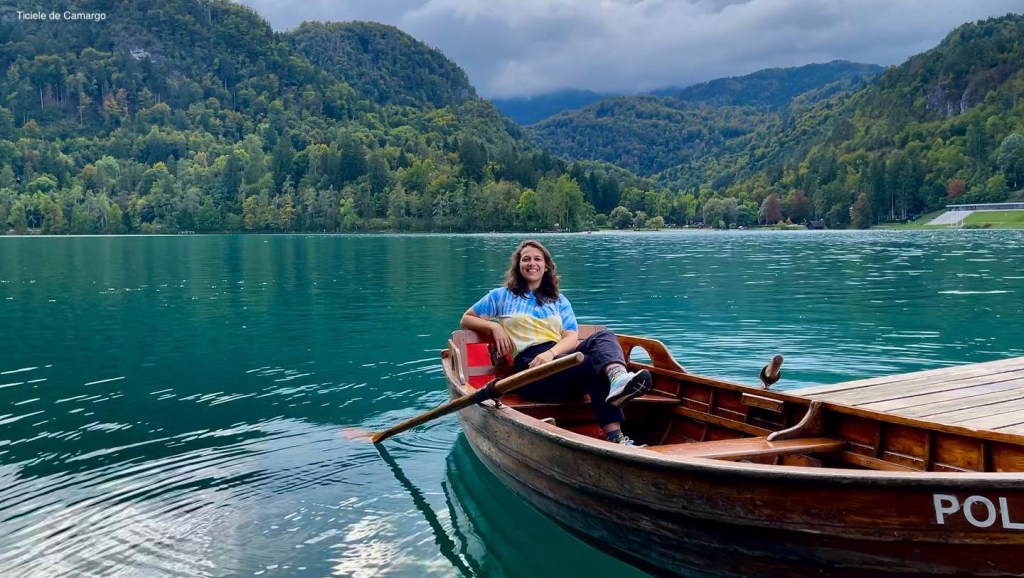
Lake Bled, Slovenia. Ticiele de Camargo. -
Sit tight; the window seat is YOURS. Enjoy the view!
BY
ON
São Paulo, Guarulhos, views from above – window seat, THE 29A. My family and I were in a taxi, making our way to Guarulhos International Airport (São Paulo, Brazil) a couple of days ago. Although we flew in on the same flight, our return flight to London was scheduled at different hours. My family’s flight was scheduled for 2:30 pm and my flight was scheduled for 7:15 pm the same day, meaning I’d wait for some hours.
Although I’ve been flying in and out as an expatriate for two decades now, there is something still unbearable about leaving our homeland: saying goodbye to the ones that we love. And, this trip, specifically, was not a holiday; it was a family emergency.
On that note, I wasn’t feeling very cheerful on that day, but I kept it in, as I usually do, and didn’t mention a word to anyone.
In the taxi, my mother said: Tici, what if you try asking the airline to move you to our flight, so we can go together? She said that so confidently (never doubt the mother’s instinct).
I thought that was not going to be possible since I know some companies do not offer this free of charge, nor have the flexibility, and it’s a request completely based on availability. So I tried, and the response was negative; the flight was full.
Okay.I moved to another counter (I’m quite persistent) and approached another agent, a young man, “Boa tarde, would you mind checking and possibly placing me on an earlier flight, please?” His all-hands-on-deck attitude spoke millions. “Of course, in fact, we only have ONE seat available, which is 29A, a window seat.” Amazed, I replied: “That’s awesome, I’d love that then, please do your magic, and thank you so much.”
That made me a bit more cheerful. Although I wasn’t going to fly with my family, at least I was conveniently boarding earlier AND landing earlier.
Well, the story does not just end here. My new flight was scheduled for 2:10 pm; it was 12:35 pm, and I still needed to go through security checks and Fed authorities. So I quickly updated my family on the new flight details (my mother was super pleased!) and I rushed on.
Soon, I boarded the plane and took my seat at 29A, the perfect window seat. Then, a young Spanish gentleman approached. “¿Hablas Español?” I nodded, ¿Te molestaría cambiar con mi novia?” He was asking me to move seats so his girlfriend could sit with him.
The seat layout for that aircraft, to clarify, was A-B, C-D-E-F, G-H. His seat was 29B, and his beloved girlfriend, 27B.
I generally try not to decline little favours, but this time, I felt like I should. And a couple of reasons and explanations crossed my mind within seconds to justify my reason for declining it, but I just said that I preferred staying in my original seat: 29A. I then kindly suggested he ask another passenger to swap, and he did it.
Guess what? It worked. They sat together! An elderly man agreed to move seats. So, who sat next to me? Nobody. It was free! Yeeha!This made me reflect on the times that we tell God things our heart desires. But there are times (most of them) that we DO NOT even need to tell Him. He moves things around for us. Be it little things or not, He does.
In our human ways, we make plans, but God comes and shows us that He has more than plans; He has purpose, whether it is gifting you with the window seat just to make your day brighter. If the Creator of the entire universe controls every single atom, dust, deep seas, and infinite galaxies, what would not he do for us?!
I praise God for landing safely, feeling immense gratitude and reflecting on these verses composed around the 6th century BCE, which remain very much alive and relevant to this very day.
“For my thoughts are not your thoughts, neither are your ways my ways,”… “As the heavens are higher than the earth, so are my ways higher than your ways and my thoughts than your thoughts.”
Isaiah 55:8-9
I understand that it is considerate to swap seats, and I have done so in the past. However, I have also come to understand that when God, by his grace, presents you with an opportunity, it’s important to honour it. So, keep your position. Sit tight. Stay where you are. Enjoy the view. His blessings will continue to flow, one after another – even those things you never imagined experiencing.
I invite you to embrace this wonderfully gentle love from above, and I promise you won’t be let down.
There is so much He can do, whether little things and who knows, the next time, a first-class seat?
Everything is possible 🙂All blessings,
Tici.
-
👽-te
BY
ON
ALIENA-TE
DAQUILO QUE TE PESA,
ALIENA-TE
DAQUILO QUE TIRA TEU SOSSEGO,
ALIENA-TE
DE TUDO O QUE NÃO É LEVE,
ALIENA-TE.
Aliena-te,
TODAS AS VEZES QUE SEU PLANETA
SE SENTIR EM AMEAÇA.
ALIENA-TE, POIS UM DIA,
O CAÇADOR VIRA CAÇA.
E A VIDA, SEGUE SENDO VIDA,
PARA UNS, CHEIA INFORTÚNIOS
E INCÔMODOS.
MAS AOS SÁBIOS ALIENADOS,
CHEIA DE GRAÇA.
Alienate yourself
from what weighs you down,
Alienate yourselffrom that which takes away your
peace,Alienate yourself
from everything that is not
light,Alienate yourself,
everytime your planet feels
threatened.Alienate yourself, for one day the
hunter becomes the prey.And life is still life, for
some, full of misfortunes and discomforts.But to
the wise alienated,It is FULL OF GRACE.
TICIELE DE CAMARGO ©️ 2022
-
Remember ✍🏼
BY
ON

Composed on the plane to Tel Aviv, early June 2022 -
We drink the Truth
BY
ON
On a Monday morning,
holding my coffee, nicely brewed
I look through my window, quickly,
and feel the gentle touch coming from my drink, warming
– making all anew.
Suddenly, it comes to thought:
”What if today is final?
”What if this is just a play?”
”Will I be satisfied with my coffee?”
”Will this be the best part of my day?”
These thoughts, surprisingly, vanish.
Just like the taste of the coffee in my mouth
flowing to the sides and sliding down in joy,
sending the fulfilling affirmation to my brain: all is well.
The mind goes and dwells somewhere else,
and so does the coffee
but,
there, in the slightest conceptions that we keep within
about coffee, about brewing, tastes, life and satisfaction
there, right there, there is truth.
That is why we drink it.We drink the Truth – Ticiele de Camargo, 15th Nov, 2021. London.
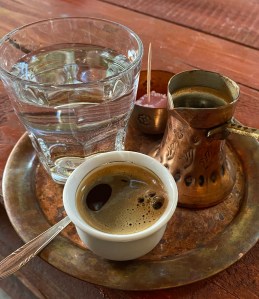
Balkan coffee, BOSNIA-HERZEGOVINA. Sept 2021 -
Lá-crime-mas
BY
ON
Deveria ser um crime trazer danos aos poetas
Ou talvez, um grande favor,
Assim continuam a prender em linhas
Aqueles que buscam por liberdade.
Deveria ser um crime fazer os poetas chorarem
Ou talvez, um grande favor,
Assim continuam a salgar suas almas
Junto aos gritos de lá-crime-mas.
Deveria ser um crime confiar em poetas
Ou talvez, um grande favor,
Assim continuam a duvidar dos pequenos gestos diante de grandes ruínas trazendo dor.
Deveria ser um crime ouvir os poetas,
Ou talvez, um grande favor
À humanidade,
Assim aprenderiam os bons sobre
o intolerável peso que a insensibilidade tem
Ao brincar com a felicidade
Numa gangorra chamada Amor.
Deveria ser um crime acreditar nos poetas,
Ou talvez, um grande favor,
Pois poetas visitam sentimentos aprisionados
Em contratempos irreversíveis.
E os questionam os porquês;
devastar sentimentos, é o pior crime de todos – e os poetas sabem – nenhum réu merece o céu diante disso.
Ticiele de Camargo ©️ July 2021.

-
A p a z recer
BY
ON
Quando a paz aparecer
de forma singular e inesperada, no dia a dia,
E em perfeita sincronia
Te fizer refletir,
diante dessa ansiedade imperfeita que carrega, dessa agonia – dentro de ti,
Quando ela, a paz-recer,
Por gentileza:
Feche os olhos
E a convide para ficar.
Ela, em sua gentil grandeza e humildade,
Mudará o rumo da ansiedade nos tapas.
E quando essa aparecer, ou quiser voltar,
Verá que essa tal de habitação já não é mais a sua casa.
Little they knew about peace until the day they saw, its wings, from high above, flapping over the sorrow of their gentle hearts.
Ticiele de Camargo ©️ 2021.
-
Boas novas
BY
ON
Olhou no profundo desse verde e
Agarrou-se no frescor das boas novas.
Sentiu algo profundamente pacífico.
E entendeu que, aqueles que pouco almejam as coisas desse mundo,
são os que conhecem o Pai intimamente.
Ticiele de Camargo ©️ 2021.


-
Subscribe
Subscribed
Already have a WordPress.com account? Log in now.
 Ticiele de Camargo